 LotsTeam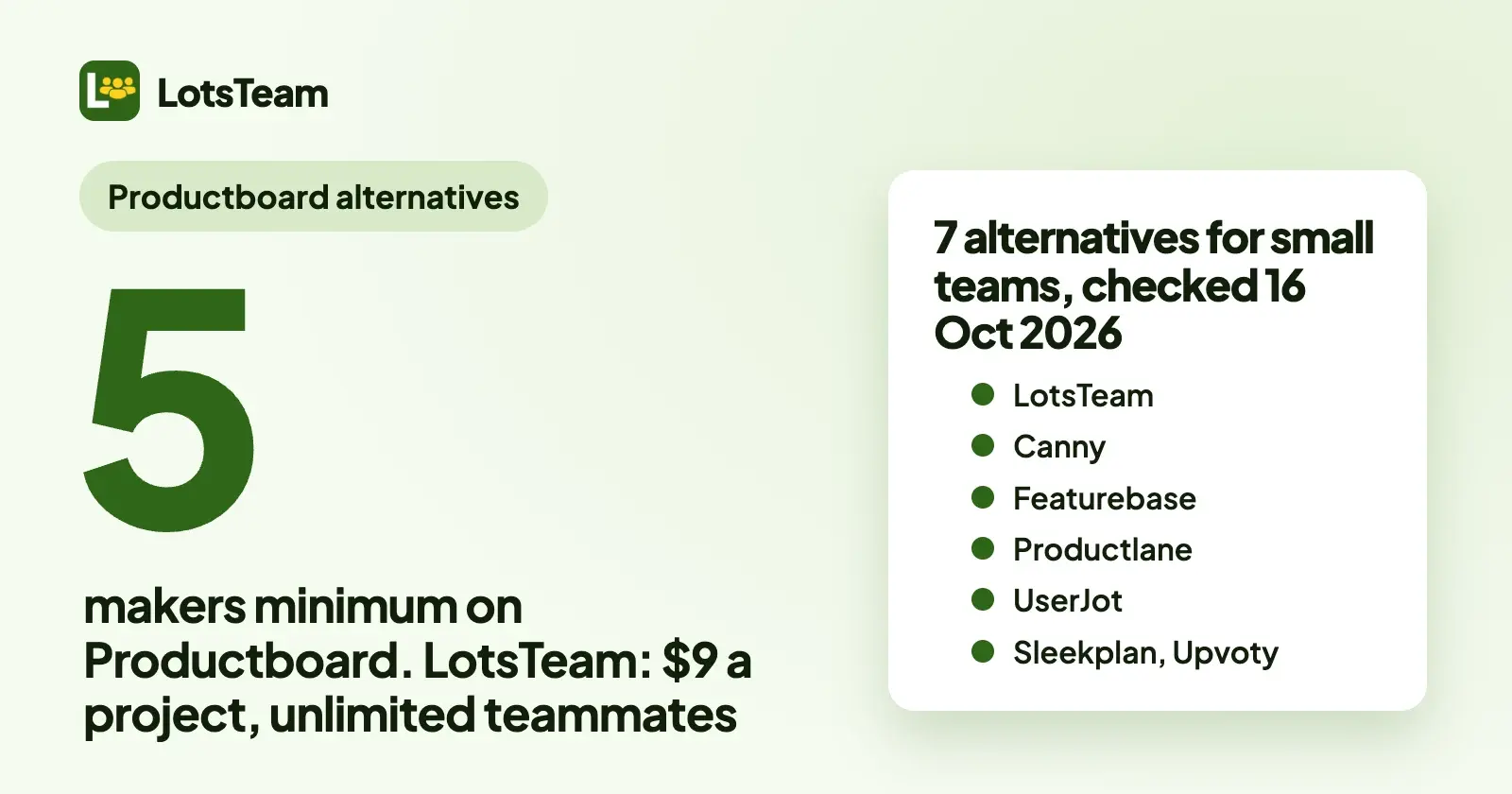
If you're a founder or a small team, you probably don't need Productboard. It's priced per maker with a five-maker minimum and no public prices. For requests, tasks, support and a changelog run from your AI agent, LotsTeam costs $9 per project with unlimited team members. For a feedback board with an MCP server, look at Canny, Featurebase, UserJot, Sleekplan or Upvoty.
Productboard is a strong product management platform, built for product organisations with several product managers. Below I explain what it's for and how it charges, who undergrows or outgrows it, and seven alternatives that fit a small team working in ChatGPT, Claude or Claude Code. In LotsTeam a "post" means a piece of product feedback, such as a request, a bug or an idea, and a "project" is one product's workspace.
Checked on 16 October 2026: every price and feature below comes from each vendor's own pricing page, docs or MCP page, opened that day. Links are at the end.
What Productboard is for
Productboard helps product teams turn customer feedback into priorities, roadmaps and specs. Feedback arrives as "notes" from email, support tools, calls and a Chrome extension; you link notes to features as insights; you score features with custom prioritisation formulas; and you plan releases, initiatives and objectives on timeline roadmaps. Spark, its AI, summarises feedback, finds themes and drafts documents such as specs. Work goes to engineering through Jira or Azure DevOps.
Here is how it charges, from its pricing page:
- Two plans: Business and Enterprise. Neither lists a price. Business has a "Request demo" button and Enterprise "Contact sales". Annual billing shows "Save 21%".
- You pay per maker, with a minimum of five. Makers are the product managers and leads who own roadmaps and priorities, and the FAQ says pricing is based on the number of makers. Both plans list five as the minimum. Contributors, the colleagues who submit feedback and comment, don't count as makers: Business includes 25, Enterprise unlimited.
- AI runs on credits. Business includes 500 credits per maker a month; Enterprise 1,500 base credits plus 800 per additional maker. Productboard's own examples: analysing 100 feedback items uses about 30 to 50 credits, a full spec 50 to 200. Top-ups are 50 credits for $5 on monthly plans or 600 credits for $60 a year on annual plans. When credits run out you keep your workspace and only the AI features pause.
- MCP is on both plans. The plan table lists "MCP Server" and "MCP Connectors" on Business and Enterprise. Its MCP page gives
https://mcp.productboard.com, signs in with OAuth, and works with Claude, ChatGPT, Claude Code, Codex and Cursor. An admin enables it for the workspace and chooses which roles may connect, and an agent can create and update features, initiatives, releases, objectives, key results, feedback and documents, and change prioritisation fields.
Who undergrows Productboard, and who outgrows it
You undergrow it when there's one person, or two, deciding what to build. A five-maker minimum is built for a product organisation, not for a founder and a developer. Small teams also tend to need things Productboard leaves to other tools: a support inbox, a task board the developer works from, and a changelog that tells the people who asked. Productboard's Business plan does include "Notify idea & feedback contributors" and two product portals, but delivery lives in Jira or Azure DevOps.
You fit it when several product managers share one view of customer evidence, weigh features by customer and segment, and plan releases against objectives. That's where its insights, scoring and roadmaps earn their price.
You outgrow Business when you need SAML SSO and SCIM, custom roles, Salesforce, unlimited contributors or audit logs: those are on Enterprise. At that size UserVoice is the other name people compare; its pricing page says it prices by feedback volume, tools and integrations, never by seat, through sales.
The rest of this page is for the first group.
Productboard alternatives at a glance
| Tool | What you pay for | Starting price | Tasks or issue tracker | Changelog | MCP for your agent |
|---|---|---|---|---|---|
| LotsTeam | Projects; unlimited team members | $9 per project, or $24 for 3 | Built-in task board linked to requests | Yes, can email the people who asked | Every plan, plus REST API |
| Canny | Tracked users | Free for 25 tracked users; Pro from $79 a month, billed yearly | Jira, ClickUp, Linear, Asana, GitHub, Azure DevOps | Yes | Any paid plan, 55+ tools |
| Featurebase | Seats | Free (1 seat); Growth $29 per seat a month, billed yearly | Linear, Jira and others from Growth | Yes | All paid plans |
| Productlane | Users | $29 per user a month, billed yearly | Linear, every plan | Yes | Needs an active plan or trial |
| UserJot | Plan; unlimited users | Free; Starter $29, Professional $59 | Integrations from Starter | Yes, every plan | Starter and Professional, 80 tools |
| Sleekplan | Plan, with seats per plan | Free; Starter $13 a month, billed yearly | Jira from Starter; Linear too | Yes, every plan | Every paid plan, 14 tools |
| Upvoty | Plan; unlimited tracked users | $15, $25 or $49 a month | Integrations from Super | From Super ($25) | Hyper ($49) |
| Productboard | Makers, five minimum | Not listed; demo or sales | Jira, Azure DevOps | Portals and contributor notifications | Business and Enterprise |
1. LotsTeam: the whole loop for one price per product, run from your agent
LotsTeam keeps user requests, the tasks behind them, support messages and the changelog in one workspace, and your agent runs it through the MCP server at https://api.lots.team/mcp. A feedback widget and a public portal with votes collect requests, bugs and ideas. Your agent reads and prioritises them, logs a request you heard on a call, merges duplicates, creates a task and links the posts to it. When the work ships, it drafts the changelog entry, and if the entry is linked to a task with requests behind it, you can choose to email the people who asked.
That's the part of Productboard a small team actually uses (collect, decide, ship, tell people), without a separate tracker and helpdesk around it. The thinking Spark does inside Productboard, your own agent does here: ask Claude or ChatGPT which requests matter most and why, and it works on your real posts and votes.
- You pay for products, not people. $9 per project a month on pay as you go, or plans of $24 for 3 projects, $69 for 10 and $159 for 30. Yearly billing is ten times the monthly price. Organizations and team members are unlimited, and Pro and Business also include LotsNotes Pro.
- No credits for AI inside the product. Your agent's own plan pays for the reasoning, so there's no per-maker credit allowance to watch.
- MCP and REST on every plan, including pay as you go. The agent signs in with OAuth and acts with the signed-in person's permissions: a viewer reads, a member works only in the projects assigned to them.
- A task board next to the requests. A task can carry many posts, so three people asking for the same thing in different words all sit on one task. More in The Best Tools to Link Feedback to Tasks.
- Support replies you approve. The agent reads a support thread and prepares a reply. Sending needs your instruction, and a sent reply emails the customer.
- No feature gates by plan. Custom domain, support inbox, roles and the changelog are on every plan.
- A free start: 10,000 free credits, valid 90 days, with no card. That covers one project for a month.
What it doesn't have: prioritisation formulas and scores, an objectives and initiatives hierarchy, Jira or Linear sync, and an importer. If your engineers live in Jira, the tools further down connect to it.
Choose LotsTeam if you're a founder or a lean team, you work in an AI agent, and you want requests, tasks, support and the changelog at one flat price per product.
2. Canny: the feedback specialist with automatic capture
Canny is the closest thing to Productboard's feedback side for a smaller budget. Autopilot, on every plan including Free, finds feedback in support chats and sales calls (Intercom, Zendesk, Freshdesk, Gong, Zoom and more) and merges duplicates. Free covers 25 tracked users and Pro starts at $79 a month billed yearly for 100 or more, rising with the number of people who give feedback. Contributors are unlimited; Free has 5 managers and Pro 10. Project management integrations (Jira, ClickUp, Linear, Asana, GitHub, Azure DevOps) are on Pro. Its MCP server, on any paid plan, works with ChatGPT, Claude and Cursor and exposes over 55 tools. More in Canny Alternatives and LotsTeam vs Canny.
Choose Canny if you want feedback captured from calls and chats automatically, the way Productboard pulls in notes.
3. Featurebase: feedback and a full helpdesk in one suite
Featurebase pairs feedback boards, roadmaps and a changelog with a helpdesk: live chat, a unified inbox and ticketing, a help center and its Fibi AI agent at $0.49 per resolution. The free plan has one seat. Growth is $29 per seat a month, Professional $59 and Enterprise $99, billed yearly, and the API, MCP and webhooks start on Growth; its help center says the MCP server is on all paid plans. Startups founded less than two years ago with fewer than six employees can apply for 86% off. More in Featurebase Alternatives.
Choose Featurebase if support volume is what you're really managing and you want feedback beside it.
4. Productlane: support-led, built around Linear
Productlane is a support platform for teams whose engineering runs on Linear: an inbox for email, live chat and Slack (Slack from Pro), the Productlane Agent that resolves tickets, a feedback portal, a self-updating help center and a changelog. Starter is $29 per user a month, Pro $59 and Scale $99, billed yearly, with 25, 50 or 100 AI resolutions included and $0.79 each after that. Linear integration is on every plan. Its MCP docs say MCP needs an active plan or trial, and each tool is gated by the scopes you grant. More in LotsTeam vs Productlane.
Choose Productlane if your developers live in Linear and support is a big part of the job.
5. UserJot: flat plans and a large MCP
UserJot charges for features, not seats: every plan, including Free, has unlimited users and posts, a public roadmap and a changelog. Free has 3 admin roles and 2 boards; Starter at $29 a month adds unlimited team members, a custom domain, 5 boards and one integration; Professional at $59 adds unlimited boards, integrations and SSO. Paid plans start with a 14-day trial. Its MCP server has 80 tools on Starter and Professional, and its own page says a token can reach the whole workspace, including deleting requests and changelog posts, so it recommends one token per agent. It imports from Canny and Nolt, and from anything else by CSV.
Choose UserJot if you want a flat price, lots of agent tools and an easy way to bring your data.
6. Sleekplan: feedback, changelog and surveys on a small budget
Sleekplan covers a feedback board, roadmap, changelog, NPS and CSAT, and surveys. The free Indie plan has one admin. Starter is $13 a month billed yearly with 3 team seats, the API and standard integrations such as Jira; Business is $38 billed yearly with 10 seats, surveys, a custom domain and branding removal. Paid plans have a 30-day trial with no card. Its MCP server signs in with OAuth, runs in the EU, lists 14 tools including capturing feedback, merging duplicates and publishing a changelog entry, and is included on every paid plan.
Choose Sleekplan if you want feedback plus surveys for the lowest monthly price here.
7. Upvoty: unlimited tracked users from $15
Upvoty has feedback boards, a public roadmap and a changelog. Power is $15 a month, Super $25 and Hyper $49, billed monthly (annual saves 10%), with unlimited boards and tracked users and a 14-day trial with no card. The changelog and all integrations start on Super; Hyper adds unlimited projects, the Upvoty MCP server, the API and webhooks. MCP uses the same scoped tokens as its REST API (read-only, read-write or admin), and every agent call goes into the audit log.
Choose Upvoty if you want a low flat price and are fine taking the top plan for agent access.
When to stay on Productboard
Nothing above replaces Productboard for the team it's built for:
- Customer evidence at scale. Unlimited feedback notes, insights linked to features, customer segments and product usage data from Amplitude and Mixpanel.
- Real prioritisation. Custom formulas, dependency tracking, release planning and timeline roadmaps across teamspaces.
- Spark. AI that summarises feedback, finds opportunities and drafts specs inside the workspace, with credits included per maker.
- An agent-ready workspace. Its MCP server lets Claude, ChatGPT or a coding agent create and update features, initiatives and objectives, and pull specs into Claude Code or Cursor.
- Enterprise controls on the Enterprise plan: SAML SSO, SCIM, custom roles, audit logs and Salesforce.
If you have five or more product managers sharing one roadmap, stay.
Start with your agent
Give your agent this and let it set itself up:
Read https://lots.team/skill.md and help me connect LotsTeam for you.
Then ask for the work you'd have done in Productboard:
List the open posts in my project with their votes. Group the ones that ask for the same thing and suggest the five groups I should build next, with one line on why for each. When I say yes, create a task for each and link every post in the group to it. Don't publish or email anything.
The MCP server is at https://api.lots.team/mcp (setup). New accounts start with 10,000 free credits, valid 90 days, no card. See pricing, or compare LotsTeam with other tools.
Common questions
What is the best Productboard alternative for a small team?
It depends on what you use it for. For requests, tasks, support and a changelog run from your AI agent at one price per product, LotsTeam costs $9 per project with unlimited team members. For automatic feedback capture, Canny. For a helpdesk too, Featurebase or Productlane. For the lowest flat price, Sleekplan or Upvoty.
How much does Productboard cost?
Productboard doesn't list prices. Its pricing page shows two plans, Business (request a demo) and Enterprise (contact sales), priced by the number of makers with a minimum of five on both. Annual billing saves 21%. Business includes 500 AI credits per maker a month, and extra credits cost $5 for 50 on monthly plans.
Does Productboard have a free plan?
No free plan is listed on its pricing page, which shows Business and Enterprise only. Canny, Featurebase, UserJot and Sleekplan have free plans, and LotsTeam gives new accounts 10,000 free credits, valid 90 days, with no card.
Does Productboard have an MCP server?
Yes. Its pricing page lists the MCP server on Business and Enterprise. It's at https://mcp.productboard.com, signs in with OAuth, works with Claude, ChatGPT, Claude Code, Codex and Cursor, and an admin has to enable it for the workspace first. LotsTeam's MCP server is on every plan and on pay as you go.
What is a maker in Productboard?
Makers are the product managers and leads who own the product strategy: they create roadmaps, prioritise features and manage insights. Pricing is based on the number of makers. Contributors, who submit feedback and comment, don't count toward the maker limit; Business includes 25 of them.
Can I move from Productboard to LotsTeam?
There's no importer. Your agent can log the requests that still matter as posts, with the requester's email where you have it, so they can be told when the work ships. Productboard's Business plan lists an export of feature requesters, which gives you that list.
Details checked on 16 October 2026 from each vendor's own pages: Productboard pricing (plans, plan table and FAQ) and MCP server; UserVoice pricing; Canny pricing and MCP; Featurebase pricing and MCP server help article; Productlane pricing and MCP docs; UserJot pricing and MCP; Sleekplan pricing and MCP; Upvoty pricing and MCP. LotsTeam details from lots.team/pricing and lots.team/skill.md. Prices and features change; check each vendor's page for the latest.